
To measure a replacement window, take width and height at three points, record the smallest opening dimensions, check both diagonals and document the reveal, cill and frame position. Do not deduct a universal fitting allowance: the fabricator’s system guidance, opening condition and installation specification determine the manufacturing size. The survey principles should follow BS 8213-4.
Tools You Need Before You Start
Bring a steel tape measure (fabric tapes stretch and give inaccurate results), a spirit level, and a pencil and notepad. For larger or more complex openings, a laser measure is useful for confirming heights across wide spans. Take photographs of each opening as a record — particularly any defects in the existing reveal that might affect fit.
Measuring Width and Height: The Three-Point Rule
Never measure at a single point and assume the opening is uniform. Openings in older properties are rarely perfectly square or consistent from top to bottom.
- Width — measure at three heights: top, middle, and bottom of the opening. Use the smallest of the three figures
- Height — measure at three positions: left, centre, and right. Use the smallest of the three figures
- Deduct for clearance — most manufacturers build in a standard tolerance, but confirm with your supplier how much clearance to allow on each dimension
Checking for Square
Measure both diagonals of the opening — top left to bottom right, and top right to bottom left. If the two measurements differ by more than 5mm, the opening is out of square. A new window will technically fit but may look wrong or require packing. Flag this to the client before ordering; in some cases the reveal needs remediation first.
Reveal Depth
Measure the depth of the reveal — the distance from the front face of the wall to the back. This affects how the frame will be positioned and whether a standard sub-cill or external finishing trim will work. In solid stone or brick walls the reveal is typically deeper than in modern cavity construction. Note whether there is an existing cill, and its projection, as this may need to be replaced. The finished frame position should also support the whole-window U-values required by Section 6 of the Building Standards Technical Handbooks.
Special Cases
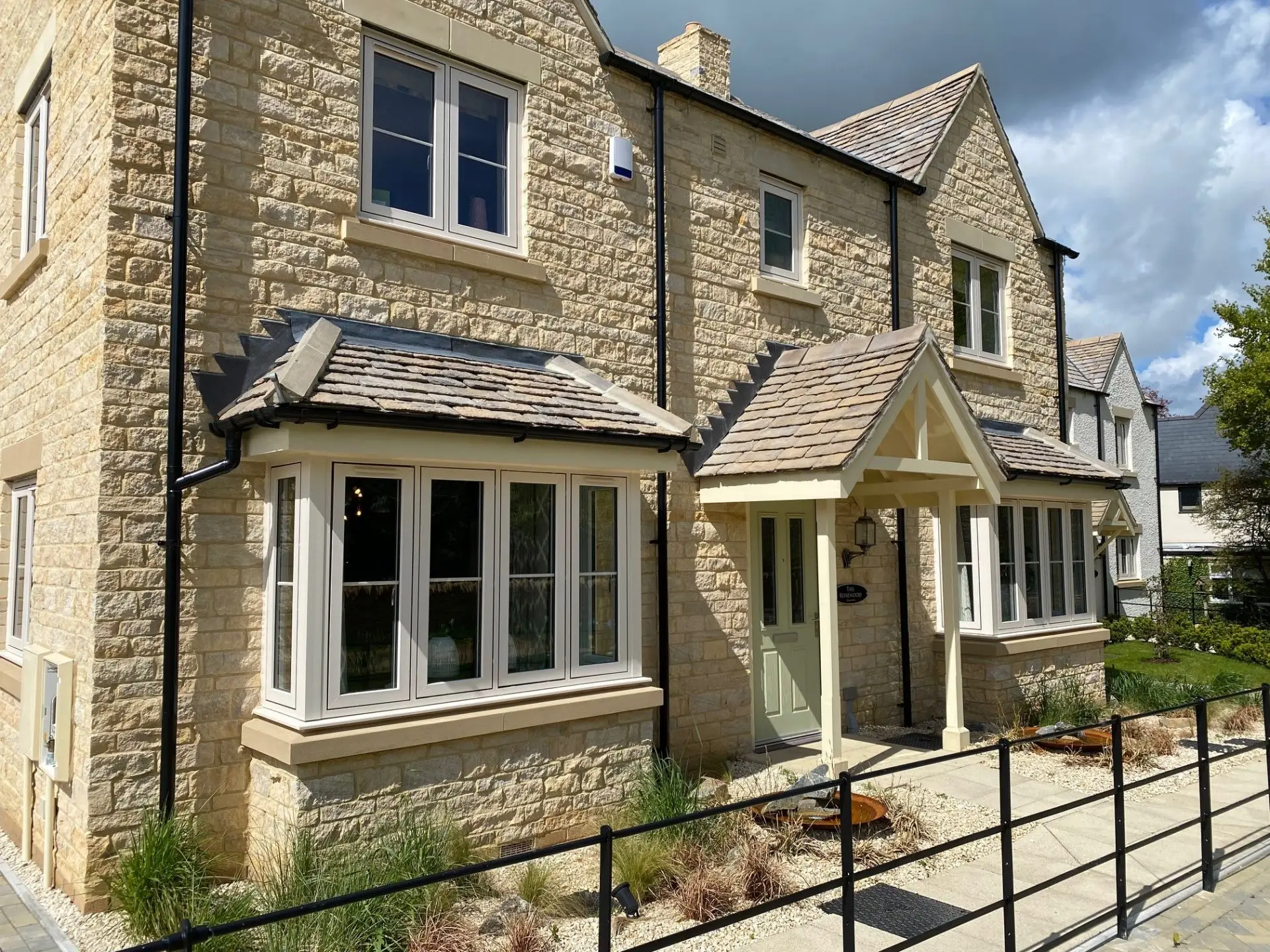
Bay windows — each section of a bay must be measured independently. Note the internal angle at the junction between sections (typically 90°, 135°, or a custom angle). The pole angle, cill height, and head height must be consistent across all sections for the finished installation to align correctly — see Clyde Windows & Construction’s bay and bow window service for an example of a correctly specified installation.
Arched or curved heads — confirm whether the arch is structural or decorative. Measure the overall width at the springing points (where the arch begins) and the height to the highest point of the arch. Shaped frames must be ordered to a template or detailed drawing.
Replacing into an existing box frame — when fitting a new PVC-u sash into an existing timber box, confirm the internal dimension of the box at three points. The new frame must sit within the box with enough clearance to square and fix without distorting the new frame.
Writing Up Your Measurements
Once you have your measurements confirmed, see our guide on how to fit a casement window for the full installation sequence. For bay window measuring specifics, read our article on bay and bow windows for trade.
Present measurements to your supplier as overall frame size (width × height), clearly labelled by room or elevation reference. Include notes on any non-standard conditions — out-of-square openings, deep reveals, arched heads, or brickwork issues. A good trade supplier will review your measurements before confirming the order and flag anything that looks unusual. Always confirm the order acknowledgement matches your survey notes before the windows go into production.